A bookmark manager with an AI assistant
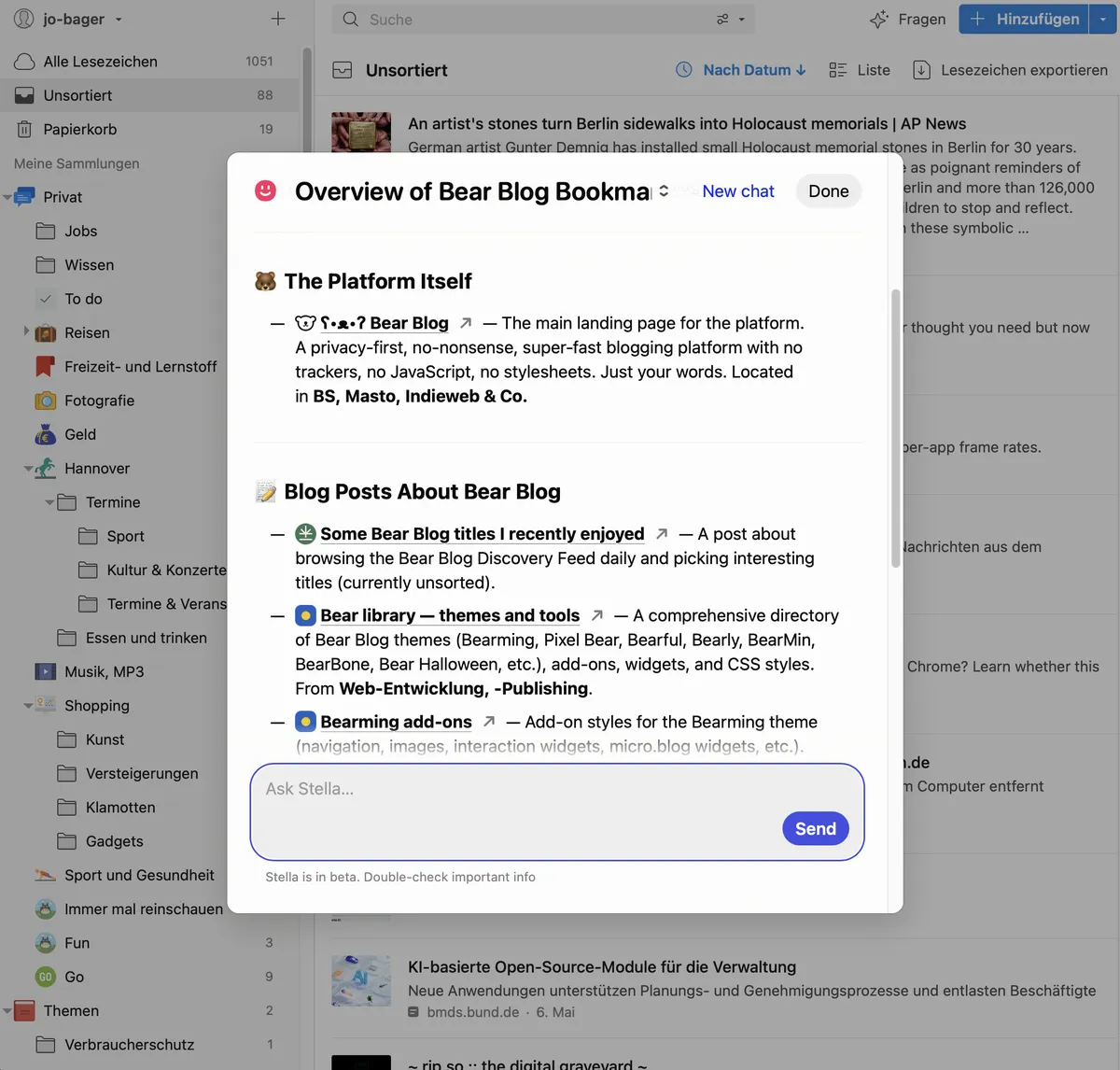
As a tech journalist, I regularly switch between Chrome, Firefox, Safari, Arc, Orion, and whatever new browser is making noise that week. The obvious consequence: browser bookmarks are essentially useless to me. Whatever I saved in one browser stays there, siloed, forgotten. So for years I've relied on an online bookmark manager: Raindrop.io.
When Raindrop recently introduced an AI assistant called Stella, my first reaction was a quiet eye-roll. I've been burned before. Microsoft's Copilot integrations in Office have so far delivered little beyond the occasional hallucination and a lot of hype. When a new AI button appears somewhere, I've learned to assume it will be impressive in a demo and disappointing in practice. But Raindrop has made me revise that assumption.
Raindrop stores static copies of every page you bookmark, extracting up to 300,000 characters of content per link, including PDFs. That means Stella isn't just searching titles and tags — she's actually reading what you saved. When I ask her to find everything in my collection related to the risks of AI agents, I get back a curated list with brief summaries of each article, not a list of vague titles I need to click through one by one. It works surprisingly well, and in German too.
Stella can also summarize saved articles, explain complex content in plain language, and help clean up your library — finding duplicates, merging tags, moving unsorted bookmarks into appropriate collections. Before she touches anything, she asks for permission.
In terms of privacy: Raindrop says Stella runs on OpenAI's open-weight GPT OSS 120B model, hosted on their own infrastructure, with user data neither leaving their servers nor being used for training. I can't independently verify that, but it's the kind of architectural choice that at least signals awareness of the issue.
That said, I don't actually use Stella directly all that often. Because here's where things get interesting: Raindrop also offers an MCP interface. Whenever I send Claude off to research something it automatically searches my bookmark library as part of that process. My collected reading becomes a first-person knowledge base that feeds into AI-assisted research, without me having to think about it. Stella is still in beta, available as early access for Pro subscribers (roughly $28 per year) in the web app.